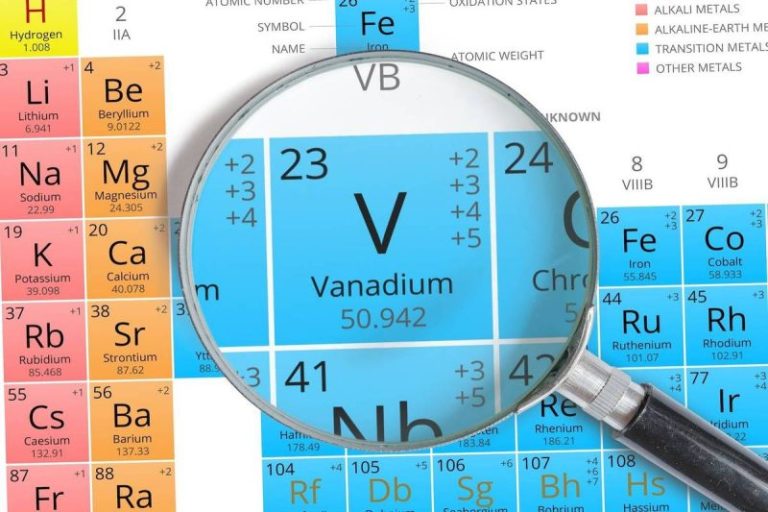
The vanadium market remained subdued in H1 2025, weighed down by persistent oversupply and weak usage from the steelmaking sector, even as new demand avenues like energy storage gained attention.
Price data shows that vanadium pentoxide in major regions such as the US, China and Europe traded in roughly the US$9,300 to US$13,000 per metric ton range in Q1 and Q2, with no dramatic price spikes. Modest support was provided by demand for vanadium redox flow batteries (VRFBs) and stricter Chinese rebar standards.
Producers reported ongoing pressure on prices and profitability, with oversupply from China and Russia continuing to temper upward momentum and buyers delaying purchases amid resilient feedstock availability.
At the same time, vanadium’s role in long‑duration energy storage, particularly VRFBs, emerged as a potential growth driver as the year progressed, hinting at deeper structural demand beyond traditional industrial uses.
“The expected growth in vanadium demand from VRFBs as an energy storage solution at the grid-level represents a bright future for increased consumption,” a July CRU report reads. “However, the present reality is vanadium consumption is still dominated by use as a ferroalloy (ferrovanadium and vanadium nitride).”
Vanadium market to see structural change?
As 2025 progressed, the vanadium market continue to grapple with weakness as steel production demand struggled to absorb available supply and the broader metals complex remained in the doldrums.
Vanadium pentoxide prices stayed under pressure in most regions, with figures from the second quarter showing US prices near US$9,584, and Chinese prices around US$8,655, reflecting tepid buying activity and ongoing oversupply, even as emerging applications such as VRFBs sustained pockets of interest.
As mentioned, a key factor has been sluggish steel sector demand. Globally, crude steel production has weakened, particularly in China — historically the largest vanadium consumer — slowing vanadium’s traditional core market as rebar and structural steel consumption softened amid broader economic headwinds.
Although new Chinese rebar standards introduced earlier in 2025 mandate higher vanadium intensity in steel, anticipated increases in consumption have only partially materialized, leaving producers competing for limited contracts and putting downward pressure on average ferrovanadium and vanadium pentoxide prices.
At the same time, market participants reported that producers were cutting output and tightening supply in response to persistent low pricing. Several companies in China and the west curtailed production or deferred capital projects, indicating that margins were strained and cost discipline was becoming an industry imperative.
Global vanadium production has been declining since 2021, when the US Geological Survey reported total global output of 105,000 metric tons; that’s compared to 2024’s 100,000 metric tons.
Emerging vanadium demand from energy storage
Despite headwinds, structural changes in vanadium demand were evident in H2 2025.
VRFBs continued to gain momentum as more utility‑scale projects were announced and commissioned. The technology’s appeal lies in its scalability, long cycle life and safety profile compared to conventional lithium‑ion systems; installations in China, Japan and North America point to a slowly growing pipeline of demand outside steel.
Industry analysts have noted that vanadium demand from VRFBs could nearly triple by 2040 as long‑duration storage becomes a more integral part of renewable power grids, even if these applications currently represent a small fraction of total consumption. In China alone, installations of large‑scale VRFB systems were projected to consume tens of thousands of metric tons of vanadium pentoxide equivalent in 2025, offsetting some weakness in steel alloying use.
This bifurcation — weak traditional demand versus nascent battery demand — typified H2, producing a market where prices remained subdued, but underlying interest in new applications suggested a shift in fundamentals.
All eyes on Australia’s vanadium potential
Although US Geological Survey data shows Australia doesn’t currently produce vanadium, the nation holds the largest recorded vanadium reserves at more than 8.5 million metric tons.
Looking to tap this potential, the country has focused its attention on the industrial metal.
In January 2025, Australian Vanadium (ASX:AVL,OTCPL:ATVVF) received environmental approval from Western Australia for the Gabanintha vanadium project. The approval, granted by Minister for Environment Reece Whitby under section 45 of the Environmental Protection Act 1986 (WA), cleared the way for construction and production.
Shortly afterwards, the company’s namesake Australian Vanadium project, located in Western Australia’s Murchison province, earned a green energy major project designation.
The Queensland government has also invested in expanding refinement and processing capacity. Last May, construction began at Queensland’s first resources common user facility at the Cleveland Bay Industrial Park in Townsville.
The facility is designed to support the development, extraction and production of critical minerals, enabling the creation of mineral samples at scale and serving as a testing hub for commercializing production processes.
The government has identified vanadium as the initial focus, highlighting its key role in renewable energy applications.
In November, Western Australia launched a AU$150 million vanadium battery energy storage system project, aiming to make the state a leader in renewable energy and energy storage.
The 50 megawatt/500 megawatt-hour flow battery will use locally sourced and processed vanadium, and is expected to be the largest of its kind in Australia, supporting advanced manufacturing and a domestic supply chain.
Growing energy storage demand meets tightening supply
Looking ahead, analysts forecast that vanadium dynamics will begin to tilt in favor of tighter supply and strengthened pricing, though the timing and pace remain contingent on several variables.
A combination of reduced output and rising consumption — particularly from VRFBs — is expected to push the market toward a deficit by late 2026, encouraging a gradual recovery in vanadium prices.
Central to that shift is the energy transition. Demand for vanadium in long‑duration energy storage is projected to rise sharply as utilities and grid operators seek cost‑effective solutions to buffer renewables and stabilize electricity systems.
The vanadium market’s long‑term promise is underpinned by projections that VRFB deployment could grow at double‑digit rates, even as the bulk of demand remains tied to steel alloying.
On the supply side, a cautionary mood among producers — reflected in delayed project developments and tighter output discipline — may limit new material flowing onto the market in 2026.
With prices remaining below historical averages, many potential expansions are unbankable in the current price environment, meaning that new supply additions are likely to be limited absent a sustained price uptick.
“Vanadium market prices are likely to rise from late 2026, supported by tightening supply and growing demand from VRFBs. With weak prices in 2024 and 2025, driven by sluggish steel demand, vanadium producers have curbed output,” a CRU report published this past December notes.
Analysts at CRU project a late-year rebound, but caution that demand could triple by 2040 far outpacing production.
“Meanwhile VRFB demand is accelerating, evidenced by robust vanadium electrolyte project pipeline,” the firm’s report continues. “Rising demand will quickly run into depressed production, where prices will need to increase to support higher utilisation rates in mid-to late 2026.”
Securities Disclosure: I, Georgia Williams, hold no direct investment interest in any company mentioned in this article.
This post appeared first on investingnews.com